DeepSeek V4.1-Flash: 552B Params, 890 Bytes of KV Cache Per Token


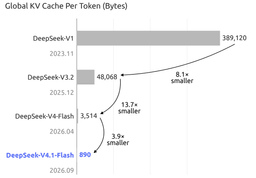
DeepSeek released V4.1-Flash on September 10, 2026, publishing the weights on Hugging Face under an MIT licence the same day the model went live in its apps. The headline is not the parameter count but the memory footprint: a 552-billion-parameter Mixture-of-Experts backbone that holds a one-million-token context in 890 bytes of KV cache per token — roughly a quarter of what V4-Flash needed five months ago, and 1/437th of what the original DeepSeek V1 required in 2023. DeepSeek says the model beats its own flagship, V4-Pro, on agentic coding benchmarks, and from September 14 all deepseek-v4-pro API traffic routes to V4.1-Flash at Flash prices.
Advanced

Technical Details
V4.1-Flash departs from the decoder-only stack DeepSeek has shipped since V1. The model card describes a Causal Encoder-Decoder (CED) architecture: 40 Transformer layers split into a 20-layer causal encoder followed by a 20-layer decoder. That split is what produces the model’s unusual activation profile — 8B parameters active per token during prefill, 16B during decode, against a 552B backbone. Each MoE layer carries one shared expert and 384 routed experts, of which six fire per token.
The asymmetry is deliberate. As the model card puts it, the design allows the model “to activate only 8B parameters per token during prefill and 16B during decode, substantially improving cost efficiency for input-heavy agentic workloads” — that is, the workloads where an agent reads a large repository or a long tool-output log and writes comparatively little back.
Training ran on a 45-trillion-token multimodal corpus. Sparse attention was trained at a 64K sequence length, with the context window extended to one million tokens 34 trillion tokens into the run. Post-training followed an SFT → RL → on-policy distillation pipeline. The instruct model exposes a continuously controllable reasoning effort parameter on a 1–100 scale. Context is 1M tokens in and up to 384K out.
How the Cache Gets to 890 Bytes
Two mechanisms stack. The first is Compressed Sparse Attention 2 (CSA2), which assigns every attention layer one of three static modes rather than letting each layer do its own bookkeeping:
- Full — builds a fresh global KV cache and selects which prior context entries matter.
- Reindex — shares an existing cache but computes its own selection of relevant entries.
- Reuse — shares both the cache and the preceding layer’s sparse-attention indices.
Because the mode assignment is static, the sparse indices are computed once and reused across layers instead of being recomputed per layer, and a hierarchical sparse indexer in the decoder handles the selection. The second mechanism is FP4 main KV caching in E2M1 format, with one E4M3 scale factor per 16 channels — quantisation applied to the cache directly rather than as a separate pass. Together they yield the 890-byte figure, a 3.9× reduction against V4-Flash’s 3,514 bytes. DeepSeek reports SSD storage for the cache at roughly one-eighth of the previous generation.
Benchmarks
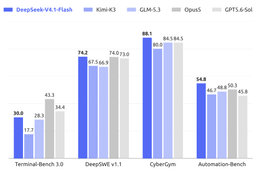
On DeepSeek’s own numbers at maximum reasoning effort, V4.1-Flash resolves 74.2% of DeepSWE v1.1 tasks against 74.0 for Claude Opus 5 and 62.7 for V4-Pro, and scores 90.6 on Terminal-Bench 2.1, 90.9 on GPQA Diamond, 93.0 on GSM8K and a 3471 Codeforces rating. It leads the comparison set on CyberGym (88.1) and Automation-Bench (54.8).
The model card’s own chart also shows where it does not lead. On Terminal-Bench 3.0 — the harder successor benchmark — V4.1-Flash scores 30.0 against Opus 5 at 43.3 and GPT-5.6 Sol at 34.4. On Terminal-Bench 4.0 it reports 31.2; DataNorth notes GPT-6 Astra at 57.9 on the same test, calling that gap “the missing row” for teams picking a coding agent today.
Independent testing lands lower than the self-reported figures. Vals AI measures Terminal-Bench 2.1 at 74.53% rather than 90.6, and places the model at 57.86% on its composite Vals Index — 15th of 56 models overall, but first among open-weight entries, 0.05 points ahead of Kimi K3 at roughly a fortieth of the cost per test ($0.303). It ranks first on Vals’s SkillsBench at 69.80%, and gained 4.3 index points over V4-Flash-0731.
What This Means
The cost structure is the story. Off-peak API pricing is $0.15 per million input tokens and $0.60 per million output, with cache hits at $0.003; peak rates double that. When V4-Pro requests begin routing to V4.1-Flash on September 14 at 12:00 Beijing time, users of DeepSeek’s flagship will be billed at roughly a quarter of what they paid before, for a model DeepSeek claims is better at agentic coding. Two of the three variables in the agent-cost equation — context length, price per token, and KV memory — move in the same direction at once here, and the third was already at one million.
For anyone planning to run the weights rather than the API, the gap in the release is deployment guidance. DeepSeek publishes no minimum hardware configuration for self-hosting a 552B checkpoint and no tokens-per-second figures. The MIT licence and the Hugging Face download are real; a reproducible serving recipe is not yet part of the package. The 890-byte cache makes million-token contexts arithmetically tractable on far less memory than before — 890 MB for a full million-token window, against 3.5 GB for V4-Flash — but the backbone still has to fit somewhere first.
Related Coverage
- DeepSeek Open-Sources V4-Flash-Vision-Exp Ten Days After API Launch — the September 1 release whose API model name now routes to V4.1-Flash.
- DeepSeek V4-Pro Leaves Preview as API Prices Rise — the August price increase that this release reverses.
- DeepSeek Releases V4: Open-Source 1.6T MoE with 1M Context — the April launch that established the 1M-token target.
- Kimi K3 Open Weights Ship: 2.8T Parameters, 1.4 TB to Run — the open-weight model V4.1-Flash just edged out on the Vals Index.
- GLM-5.3-Flash: 320B Multimodal MoE, Weights on Day One — a comparison model in DeepSeek’s own benchmark chart.
This post was drafted with AI assistance and reviewed by RITS staff.
Sources
- deepseek-ai/DeepSeek-V4.1-Flash — model card, Hugging Face
- DeepSeek API Docs — Change Log
- SiliconANGLE — DeepSeek releases V4.1-Flash, says it outperforms flagship V4-Pro
- Vals AI — DeepSeek V4.1 Flash independent evaluation
- DataNorth — DeepSeek-V4.1-Flash: MIT open weights at $0.15 per million
- MarkTechPost — DeepSeek-V4.1-Flash with 1M context, FP4 KV cache and cross-layer attention reuse


 沪公网安备31011502017015号