OpenBMB Releases MiniCPM5-2B, Topping Open Models Under 4B


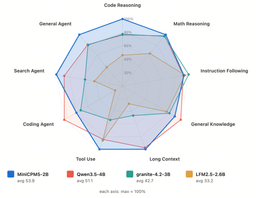
OpenBMB released MiniCPM5-2B on September 7, 2026 — a 2.5-billion-parameter dense language model, open-weight under Apache 2.0, that the team reports as the strongest open model under 4B parameters. Across 34 benchmarks spanning code, math, instruction following, long context, tool use and agentic tasks, MiniCPM5-2B averages 53.9, ahead of every 2B-class baseline in OpenBMB’s comparison set and ahead of several 4B-class models as well.
Advanced

Technical Details
MiniCPM5-2B is a conventional dense transformer rather than an exotic architecture: 2,516,756,480 total parameters (1.98B excluding embeddings), 42 layers, and grouped-query attention with 16 query heads against 2 key-value heads. It uses the standard LlamaForCausalLM class, which is part of why it slots into existing tooling so easily. The context window is 131,072 tokens.
Weights ship in BF16 with GGUF, MLX and GPTQ conversions alongside, plus a DSpark draft model for speculative decoding. Supported runtimes include Transformers, vLLM, SGLang (which OpenBMB recommends for tool calling), llama.cpp, Ollama, LM Studio, MLX and ArcLight. Via FlagOS, the model has been adapted to nine AI accelerator families: Nvidia, Hygon, Metax, Iluvatar, Zhenwu, Mthreads, Kunlunxin, Ascend and ARM-v9.

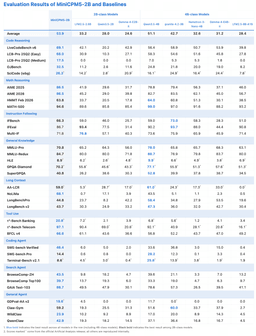
The strongest results cluster in code and math. MiniCPM5-2B scores 69.1 on LiveCodeBench v6, 86.5 on both AIME 2025 and AIME 2026, and 94.6 on MATH-500. On agentic evaluations it reports 46.4 on SWE-bench Verified — against 6.0 for LFM2.5-2.6B and 33.6 for the larger Qwen3.5-4B — and 88.7 on GAIA Text-103. Tool use is similarly strong: 97.1 on τ²-Bench Telecom and 66.6 on BFCL v4.
The gaps are just as visible in the same table. LCB-Pro 25Q2 (Medium) lands at 17.5, Terminal-Bench v2.1 at 8.6, Humanity’s Last Exam at 8.9, and SWE-bench Pro at 14.4, where Qwen3.5-4B reaches 28.2. General knowledge also trails the 4B class: 70.8 on MMLU-Pro against Qwen3.5-4B’s 78.0. OpenBMB notes in the table footnotes that scores marked with a dagger come from official Artificial Analysis releases while the rest were reproduced internally.
How the Model Was Trained

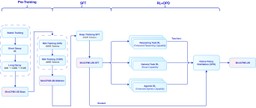
The training recipe is where the release is most interesting. OpenBMB describes a three-stage pipeline — base training, mid-training, post-training — where post-training begins with 400 billion tokens of what the team calls “deep-thinking SFT.” Reinforcement learning then runs with separate specialist teachers for mathematics, code, agentic behaviour and writing. Rather than shipping a router or a mixture, the final step applies On-Policy Distillation (OPD) to fold those teachers back into a single dense model, merging the capabilities of 16 expert models into the released checkpoint.

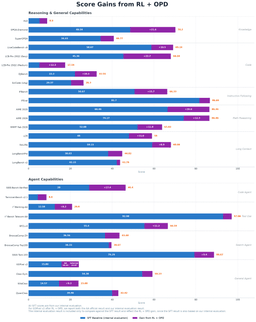
OpenBMB attributes an average gain of 10.96 points on reasoning and general capabilities to the RL + OPD stage, and 6.96 points on agentic capabilities. The per-benchmark breakdown shows where that average comes from: GPQA-Diamond rises 21.6 points over the SFT baseline, LCB-Pro 25Q2 (Easy) 22.7 points, AIME 2025 20.0 points, and SWE-bench Verified 17.4 points. Benchmarks already near their ceiling after SFT — IFEval at 81.7, τ²-Bench Telecom at 93.0 — move only a few points. The same recipe was applied to MiniCPM5-1B, released May 19, 2026, where OpenBMB reports a 16-point average lift.
The supporting datasets are also public: Ultra-FineWeb for pre-training, UltraData-Code, UltraData-SFT-Agent-2609 (500K agent samples) and UltraData-RL-2609 (80K+ RL samples).
What This Means
Third-party measurement puts the ranking claim on firmer ground than a vendor table alone would. Artificial Analysis writes that MiniCPM5-2B has “the highest Intelligence Index of any open weights model under 4B total parameters,” placing it above granite-4.2-3B and level with Qwen3.5 9B at roughly a quarter of the parameters. The absolute index number depends on which revision you read: Artificial Analysis scored it 15 on Index v4.2 and currently lists 14 on v4.3, while OpenBMB’s own launch announcement cited 23 on the Intelligence Index and 20 on the Agentic Index. Index scores are not comparable across revisions, so the ranking travels better than the number.
The efficiency figure may matter more than the ranking. Artificial Analysis measures MiniCPM5-2B at roughly 19,000 output tokens per task, 11,000 of them reasoning tokens — joint-lowest in its set, where Ling 3.0 Tiny spends about 56,000 tokens for marginally better results. For anyone running a reasoning model on a phone, a laptop or an embedded board, token budget is latency and battery, not just cost.
The practical read is that a 2.5B dense model with a 131k context and credible tool-use scores is now a reasonable substrate for on-device agents, and the nine-chip FlagOS coverage makes that portable well beyond CUDA. The weaker results on hard coding, terminal tasks and general knowledge mark the boundary: this is a model for constrained, tool-mediated work, not a general-purpose replacement for a frontier system.
Related Coverage
- MiniCPM-V 4.6: A 1.3B Multimodal Model Built for Phones — OpenBMB’s multimodal line, covering the same on-device target from the vision side
- Qwen 3.5 Small Models: 9B Parameters That Beat 120B — the Qwen3.5 family that supplies most of the baselines in OpenBMB’s comparison table
- Cactus Releases Needle: A 26M Distilled Model for On-Device Tool Calling — distillation pushed to the opposite extreme of the size range
This post was drafted with AI assistance and reviewed by RITS staff.


 沪公网安备31011502017015号