IntermediateAI
Gradium Open-Sources Phonon, On-Device TTS at 31M Parameters
- Audio
- gradium
- on-device
- open source
- tts
Gradium open-sourced Phonon on October 20, 2026, a family of text-to-speech models at 31 and 40 million parameters that runs entirely on the device it speaks from. The company reports 7 ms to first audio on a laptop CPU, a 1.7% word error rate on its hardest English sentences, and top scores among small models in a blind listening test it commissioned — with the smallest model released under Apache 2.0.

What Shipped
Phonon comes in two sizes and three variants. Phonon 31m is English-only, ships 37 built-in voices and is 64 MB at q8. Phonon 40m comes as one model per language across English, French, German, Spanish and Portuguese, at 74.6 MB. Phonon 40m multilingual covers all five languages in a single set of weights, with 102 built-in voices.
The licence split is deliberate. The 31M English model is Apache 2.0, so it can go into commercial products without negotiation. The 40M models are CC BY-NC, with commercial use routed through Gradium. All variants handle text normalisation for numbers, dates and codes, and expose speaking-speed and loudness controls.
Gradium says the inference stack targets more than ten hardware backends — CPU through Intel, Arm and WebAssembly; GPU through CUDA, Vulkan, Metal and WebGPU; and NPUs through Apple Core ML and Snapdragon. Client packages exist for Rust, Python and Swift, with a browser package on npm. The company demonstrated the model running in a browser tab, on an Apple Watch with Wi-Fi off, and inside a Chrome extension.
Quality: The Blind Test
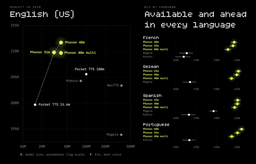
Gradium’s naturalness claim rests on a blind pairwise study: 1,189 raters casting 17,270 votes, comparing Phonon against Kokoro, Magpie, NeuTTS and Pocket TTS in each language. In English, Phonon 40m scored 2117 Elo, Phonon 31m 2098 and the multilingual model 2097. The comparison set runs Pocket TTS at 100M parameters on 2056, Kokoro on 2043, NeuTTS on 2034, a 15.6M-parameter Pocket TTS model on 1997 and Magpie on 1939.
That ordering is the release’s strongest argument, and also the one to read most carefully. The study was run by the company selling the model, and the comparison set includes the lab whose research the model builds on. The mitigating detail is that Gradium published its evaluation set — 500 hard sentences per language, drawn from cases developers reported as failures — as an open Hugging Face dataset, so the accuracy claim is at least reproducible by anyone.
Accuracy is where small models usually lose. On that set, reading the same sentences with the same four female voices per language, Phonon 31m reached 1.70% WER, the multilingual model 2.11% and Phonon 40m 2.22%. Kokoro sat at 3.50%, Kitten TTS at 7.40%, NeuTTS Nano at 8.71% and Magpie at 27.51%. The test deliberately targets phone numbers, postcodes, temperatures and version strings — the text where a synthesiser that guesses will be caught.
How It Works
Phonon is a causal transformer conditioned on text and speaker embeddings. The text goes through a SentencePiece tokenizer with a 4,000-token vocabulary, so the model reads raw characters rather than phonemes — a design choice Gradium credits for making new languages cheap to add, since no pronunciation dictionary is required.

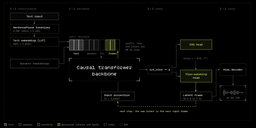
The backbone emits a 32-dimensional latent vector every 80 ms, at 12.5 frames per second. A single-step flow-matching head turns that latent, plus noise, into audio embeddings, and a reduced Mimi decoder converts them to 24 kHz PCM. A separate end-of-speech head decides when to stop. The single-step head is the efficiency trick: flow-matching decoders often need several refinement steps per frame, and at 80 ms frames that cost dominates.
Gradium is explicit about its lineage. The model extends Continuous Audio Language Model research done at Kyutai, the work that produced Pocket TTS, and the post cites Kyutai’s October 20 technical write-up on shrinking Pocket TTS to 1.9M parameters. Two teams published on-device speech models on the same day, each pointing at the other’s numbers.
What This Means
The honest framing of this release is that the quality frontier and the deployment frontier have stopped moving together. For two years, speech quality meant a large model behind an API. Phonon’s numbers — if they hold up — put a 31M-parameter model above a 100M-parameter one on naturalness while starting to speak in single-digit milliseconds on a laptop.
What that changes is where voice goes. A 64 MB model with a 7 ms first-audio latency fits inside an app, a game, a browser tab or a wearable without a network round trip. The privacy argument follows automatically: the audio never leaves the device. The limits are equally concrete — five languages, a non-commercial licence on the higher-quality variants, and benchmark WER measured on a test set built by the model’s own authors. Anyone shipping it should run their own sentences through it first, which is exactly what the published test set makes possible.
This post was drafted with AI assistance and reviewed by RITS staff.
Sources
- Gradium: “Open-Sourcing Phonon: A Suite of Frontier On-Device TTS Models” (October 20, 2026)
- Hugging Face: gradium/phonon-31m-en model card
- GitHub: gradium-ai/xn-ptts, the Phonon inference stack
- Hugging Face: gradium/tts-hard-sentences-202610 evaluation set
- Kyutai: “The tiny TTS was actually 10x too big” (October 20, 2026) — the research line Phonon cites


 沪公网安备31011502017015号