IntermediateAI
Bria’s Fibo 2.0 Puts Image Editing and Generation in One 8B Model
- Artificial Analysis
- bria
- image editing
- image generation
- open weights
Bria uploaded the Fibo 2.0 checkpoints to Hugging Face on October 18 and 19, 2026: an 8B-parameter model that generates images and edits them with the same set of weights. By Bria’s own citation of the Artificial Analysis arena, the model opened as the top open-weights entry in image editing and second in text-to-image — and it ships under a non-commercial licence.


One Model, Two Jobs
The previous generation split the work. FIBO was a text-to-image model and Fibo Edit was a separate editing model, each with its own weights and its own deployment. Fibo 2.0 merges them: one pipeline answers a short prompt by expanding it into a structured caption and rendering it, or takes a source image plus an instruction and changes only what the instruction names.
The model card lists five modes — generate, edit, masked edit with a painted region, multi-reference combining up to four images, and an “inspire” mode that borrows subject or composition from a reference without ever showing that reference to the image model. Multi-reference is the mode that matters commercially: reference-guided composition and virtual try-on were previously the domain of bespoke pipelines.


Structured Captions, Not Prompt Roulette
FIBO’s distinguishing feature has always been its training data format. Instead of short captions, the model learns from JSON descriptions of up to a thousand words that name lighting, composition, camera parameters, materials and every object in the scene as separate fields. Bria calls this Visual GenAI Language, and its practical effect is disentanglement: an edit can change the camera angle or the time of day without the rest of the image drifting.
Users do not write the JSON themselves. The bria-vgl package, which Bria open-sourced, turns a short prompt or a plain-language instruction into the structured caption, so the interface stays ordinary text while the model sees the blueprint. The card is candid that this is the mechanism behind the model’s prompt-adherence claims rather than a separate capability.
The Arena Numbers
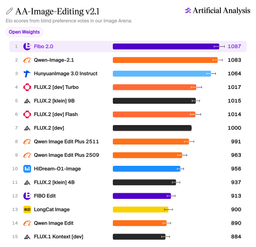
Artificial Analysis ranks image models by human pairwise preference votes, and its open-weights boards are the fairest available comparison for a model anyone can download. On AA-Image-Editing v2.1, Fibo 2.0 leads the open-weights board with 1087 Elo from 4,819 samples, with a 95% interval of 1073 to 1101. Qwen-Image-2.1 sits at 1083 (1070 to 1096) and HunyuanImage 3.0 Instruct at 1064. The top two are statistically tied; the ordering inside that interval is not a result.
On AA-Image-T2I v2.1 the positions reverse: Qwen-Image-2.1 leads at 1042 and Fibo 2.0 is second at 1039, again with overlapping intervals. Against Bria’s own previous release the move is large — FIBO scored 849 on the same text-to-image board and FIBO Edit scored 913 on editing, so this generation gains roughly 190 and 174 Elo respectively. Bria also lists $32 per 1,000 images for API access at 1024×1024, which is mid-range for the board.

What This Means
A single model for generation and editing is a deployment argument, not an aesthetic one. Two models mean two pipelines, two VRAM budgets and two sets of drift behaviours when an edit has to match a generated image. Collapsing that into one set of weights — and publishing it for local use — is a meaningful change for anyone building an asset pipeline rather than a demo.
The licence is the constraint that will decide how far it travels. CC BY-NC 4.0 permits research and personal use and forbids commercial deployment without an agreement, so the “open” here is openness of inspection rather than of production. Bria’s business is licensed, indemnified visual models for enterprises, and the open weights are the top of that funnel. Compare that with Apache 2.0 on a speech model or MIT on an inference engine, and the difference in what a small team can actually ship is larger than any Elo gap on the board.
This post was drafted with AI assistance and reviewed by RITS staff.



 沪公网安备31011502017015号