TinyGPU Brings NVIDIA and AMD eGPUs to Apple Silicon Macs


On March 31, 2026, George Hotz’s Tiny Corp announced that Apple has officially approved the TinyGPU driver extension — making it possible for Apple Silicon Mac users to run external NVIDIA and AMD GPUs over Thunderbolt/USB4 without disabling System Integrity Protection. After more than a year of engineering custom userspace GPU drivers, the approval marks the first time macOS has supported third-party discrete GPUs on Apple Silicon through an officially sanctioned mechanism.
Intermediate

Why This Matters
When Apple transitioned to its own silicon in late 2020, it dropped all eGPU support — a feature that had been available on Intel Macs with AMD graphics cards. NVIDIA never had official macOS driver support during the Apple Silicon era, and AMD’s was discontinued entirely. For researchers and developers running large AI models, this meant Apple’s otherwise capable hardware was locked to its integrated GPU and Neural Engine.
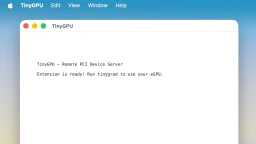
TinyGPU changes that. Built on top of the tinygrad neural network framework, TinyGPU is a macOS application that installs an Apple-approved DriverKit extension, enabling communication with external AMD (RDNA3+) and NVIDIA (Ampere+) GPUs connected via any Thunderbolt or USB4 port. No kernel extensions, no SIP bypass — just a standard driver toggle in System Settings.
How It Works
The technical path to this point was anything but simple. Tiny Corp’s journey began in May 2025, when the team demonstrated the “world’s first” AMD GPU driven over USB3 from an Apple Silicon Mac, using a reflashed ASM2464PD-based adapter (ADT-UT3G). That proof of concept required custom userspace GPU drivers and modified adapter firmware.
By October 2025, the team had NVIDIA RTX GPUs running on a MacBook Pro M3 Max over USB4, marking the first successful pairing of NVIDIA discrete graphics with an ARM-based Mac. The setup relied on tinygrad’s runtime and required disabling SIP.
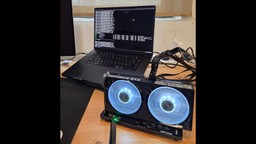
The March 2026 release wraps all of this into a clean install flow:
- Connect an external GPU enclosure via Thunderbolt or USB4
- Run the TinyGPU installer script, which downloads TinyGPU.app
- macOS prompts to install the driver extension — click Open System Settings and toggle TinyGPU on
- Install the GPU compiler (AMD’s HIP compiler runs natively; NVIDIA’s compiler runs via Docker)
- Run inference:
DEV={AMD|NV} python3 tinygrad/apps/llm.py
Performance
In Tiny Corp’s own benchmarks, a Mac mini with an M4 chip connected to a Radeon RX 7900 XTX via Thunderbolt/USB4 achieved 18.5 tokens per second running Qwen 3.5 27B — a 27-billion-parameter language model. While this doesn’t rival native PCIe throughput, it’s a practical speed for interactive inference and significantly exceeds what Apple’s integrated GPU can deliver on models of this size.
System requirements are straightforward: macOS 12.1 (Monterey) or later, a Thunderbolt or USB4 port, and either an AMD RDNA3+ or NVIDIA Ampere+ GPU. The solution also supports Linux and Windows, though the Apple-approved driver extension is macOS-specific.
What This Means for AI on Mac
TinyGPU fills a gap that has frustrated the Mac-based AI community for years. Researchers with existing NVIDIA or AMD hardware can now pair it with Apple Silicon machines for local inference, avoiding cloud compute costs. Combined with the tinygrad framework — which already supports training and inference across multiple backends — TinyGPU positions the Mac as a viable node in heterogeneous AI development setups.
The Apple approval is particularly significant: it signals that Apple is willing to allow third-party GPU compute drivers through its DriverKit framework, even for NVIDIA hardware. Whether this opens the door to broader GPU support beyond tinygrad’s runtime remains to be seen, but for now, it’s a concrete step forward.
Related Coverage
- Reverse Engineering Apple’s Neural Engine to Train Transformers on M4 — another project bypassing Apple’s official ML stack to unlock hardware capabilities
- Understanding the macOS Tahoe 26.2 Patch: Enhancing Mac Clustering Performance — recent macOS improvements for multi-device compute
- ZML: A Zig-Based Inference Engine Bringing LLMs to AMD GPUs — alternative inference stack for AMD hardware