Seedance 2.0: ByteDance’s Multimodal Audio-Video AI Model


ByteDance launched Seedance 2.0 on February 12, 2026, introducing what the company describes as a unified multimodal audio-video joint generation architecture. Unlike previous video AI models that generate video first and add audio afterward, Seedance 2.0 synthesizes audio and video simultaneously from a shared latent stream — a significant architectural shift that positions it as a direct competitor to OpenAI’s Sora 2, Google’s Veo 3.1, and Kuaishou’s Kling 3.0 in a rapidly consolidating market.

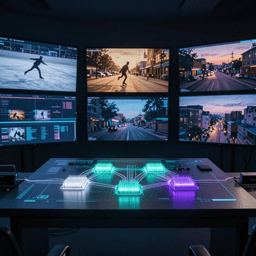
Four Modalities, One Generation Pass
The defining feature of Seedance 2.0 is its breadth of input: users can simultaneously feed the model up to 9 images, 3 video clips, 3 audio clips, and natural language instructions — 12 files in total. Each modality plays a distinct compositional role:
- Text — drives the narrative, character actions, and scene descriptions
- Image — anchors the visual style or character appearance
- Video — specifies camera movement or existing motion to replicate
- Audio — drives rhythm, synchronizes dialogue, or sets an ambient soundscape
Output videos can run up to 15 seconds at native 2K resolution, with support for multi-shot cinematic narratives — continuous scene transitions without re-prompting. Audio output is dual-channel stereo, generated in parallel with video rather than as a post-processing step, and supports phoneme-level lip-sync across more than 8 languages including dialects and singing.
How the Architecture Works
Seedance 2.0 is built on a Dual-Branch Diffusion Transformer — one branch handles video latents, the other handles audio latents, and a cross-attention layer binds them during generation. This joint diffusion approach means the timing and energy of the audio track directly influence how the video frames are denoised, which produces tighter sync than post-hoc audio grafting. ByteDance evaluated the model using its own internal benchmark suite, SeedVideoBench-2.0, testing across text-to-video, image-to-video, and multimodal task performance dimensions.
In physical motion modeling — a historically difficult area for video diffusion models — ByteDance claims significant improvements over Seedance 1.0, citing complex interactive scenes such as synchronized figure skating as test cases where the model maintains physical plausibility frame-to-frame without the jitter common to prior architectures. The company also reports a 30% faster generation speed compared to the previous generation.
Competitive Landscape
Seedance 2.0 enters a crowded field. In early February 2026 alone, Kuaishou released Kling 3.0 (February 4) with native 4K/60 fps output, while OpenAI’s Sora 2 and Google’s Veo 3.1 continue to dominate in physical realism and cinema-grade output respectively. Early comparisons position each model in a distinct niche:
- Seedance 2.0: strongest for prompt adherence, multi-shot consistency, and reference-based composition
- Sora 2: highest marks for physical realism and long-form continuity; most expensive at up to $0.50/second (Pro tier)
- Veo 3.1: most broadcast-ready output; native audio generation at cinema-standard frame rates
- Kling 3.0: fastest 4K/60 fps option; optimized for rapid prototyping
ByteDance’s approach — fusing multimodal references into a single generation pass — is seen as particularly useful for template-based production workflows and eCommerce advertising, where brand assets (images, audio logos) must consistently appear in generated content.
Access and Controversy
At launch, Seedance 2.0 is available exclusively to Chinese Douyin users via Android, iOS, and a web browser, accessible through Dreamina Web, the Doubao App chatbox, and Volcano Engine’s Model Ark Experience Center. ByteDance has stated that global access through CapCut is planned.
The release has already attracted backlash from Hollywood. The Motion Picture Association and Disney, among other organizations, have raised concerns that Seedance 2.0’s high-fidelity likeness generation and limited content guardrails enable “blatant” copyright infringement at scale — particularly through the replication of real actors’ appearances and studio intellectual property. As of the post’s publication, ByteDance had not issued a detailed public response to these claims.
Related Coverage
- OpenAI Launches Sora 2: A New Frontier in AI Video Generation — ByteDance’s primary competitor in long-form video generation
- Wan2.2: Alibaba’s Open-Source Breakthrough in AI Video Generation — another competing open model from China’s AI ecosystem
- Seaweed APT2: Real-Time Interactive Video Generation — ByteDance’s earlier streaming video research
This post was drafted with AI assistance and reviewed by RITS staff.
Sources
- ByteDance Seed — Official Launch of Seedance 2.0
- ByteDance Seed — Seedance 2.0 Technical Overview
- TechCrunch — Hollywood isn’t happy about the new Seedance 2.0 video generator
- PYMNTS — ByteDance’s Seedance 2.0 Builds Buzz in Expanding Video Generation Market
- WaveSpeedAI — Seedance 2.0 vs Kling 3.0 vs Sora 2 vs Veo 3.1 Comparison


 沪公网安备31011502017015号