Introducing Claude Sonnet 4.6: Flagship Performance at Mid-Tier Cost


Anthropic released Claude Sonnet 4.6 on February 17, 2026, bringing near-flagship-level performance to a mid-tier price point. The new model matches Claude Opus 4.6 on many benchmarks while costing five times less, cementing the Sonnet line as the go-to choice for developers and enterprises building agentic workflows, coding assistants, and knowledge-work applications.

What’s New in Sonnet 4.6
Claude Sonnet 4.6 is a broad upgrade across every capability the Sonnet line is known for. Anthropic describes it as the most capable Sonnet model yet, with significant improvements in coding, computer use, reasoning, and design tasks.
The standout headline feature is a 1 million token context window (currently in beta), making Sonnet 4.6 the first Sonnet-class model able to process entire codebases, lengthy legal contracts, or dozens of research papers in a single request. Other notable additions include adaptive and extended thinking for complex multi-step reasoning, and context compaction (also in beta) for managing long agentic sessions more efficiently.
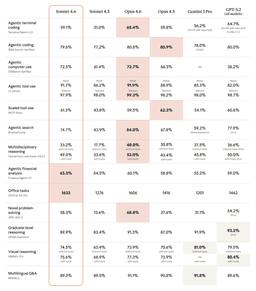
On benchmarks, Sonnet 4.6 posts scores that rival the previous flagship tier:
- 79.6% on SWE-bench Verified — within two points of Opus 4.6
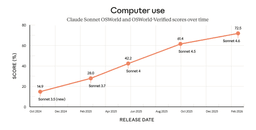
- 72.5% on OSWorld — demonstrating steady 16-month progress in computer use
- 1633 Elo on office productivity tasks, leading all tested models
- Dominates the GDPval-AA benchmark, outscoring Gemini 3 Pro by 432 Elo points

Developer and Enterprise Reception
Internal testing at Anthropic showed that developers preferred Sonnet 4.6 over Sonnet 4.5 70% of the time in Claude Code evaluations — and even chose it over the previous-generation flagship, Opus 4.5, in 59% of head-to-head comparisons. That is a striking result: a model priced at $3/$15 per million tokens outperforming one that costs significantly more in real-world developer tasks.
Early enterprise adopters echo this enthusiasm:
- Replit called the performance-to-cost ratio “extraordinary.”
- Box saw a 15-percentage-point improvement over Sonnet 4.5 on reasoning Q&A tasks.
- Pace reported 94% accuracy on insurance workflow benchmarks for computer use.
- Databricks noted it matches Opus 4.6 performance on document comprehension.
- GitHub highlighted “strong resolution rates and the kind of consistency developers need” for agentic coding.
Availability and Pricing
Claude Sonnet 4.6 is now the default model across Anthropic’s Free and Pro plans on claude.ai and Claude Cowork. It is also available in Claude Code and through the API using the identifier claude-sonnet-4-6, accessible on all major cloud platforms.
Pricing is unchanged from Sonnet 4.5: $3 per million input tokens and $15 per million output tokens. That positions it at roughly one-fifth the cost of Opus-tier models while delivering competitive or superior results on most developer-centric tasks — a combination that could accelerate enterprise adoption considerably.
Anthropic’s safety team gave Sonnet 4.6 high marks as well, concluding the model exhibits “very strong safety behaviors” with “no signs of major concerns around high-stakes forms of misalignment.”
What This Means
Claude Sonnet 4.6 continues a pattern Anthropic has cultivated over the past year: rapidly compressing the performance gap between mid-tier and flagship models. With a 1M token context window, near-Opus benchmark scores, and unchanged pricing, it raises the bar for what developers can expect from a “standard” production model. For teams running high-volume agentic pipelines or large-context coding workflows, Sonnet 4.6 may render Opus-level pricing unnecessary for many use cases.
It also signals how quickly the competitive landscape is moving. Models that were considered frontier three to six months ago are now being matched — or beaten — by more cost-efficient successors, compressing the value proposition of premium tiers across all major AI providers.
Related Coverage
- Introducing Claude Opus 4.5 — Anthropic’s previous flagship model, now outperformed on many tasks by the cheaper Sonnet 4.6
- Introducing Claude Sonnet 4.5 — the direct predecessor to this release
- Anthropic Launches Claude Opus 4.1 — earlier in the Claude 4 generation