AdvancedAI
GPU Unlock Doubles Ampere Compute, Reaches RTX 20 Series
- AI hardware
- cuda
- gpu
- inference
- nvidia
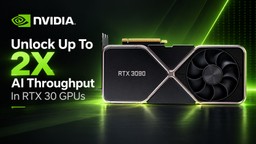
Version 1.0.0 of GPU Unlock, an open-source Linux kernel module published on October 24, 2026, removes an instruction-issue limit that NVIDIA applies to consumer Ampere cards, roughly doubling FP16 and BF16 matrix throughput on RTX 30 hardware in the project’s user-reported tests. The same technique extends to older GTX 9, GTX 10 and RTX 20 series cards, and RTX 40 owners are reporting gains too — which means a large stock of second-hand gaming GPUs can now be pushed toward the compute rates NVIDIA reserved for its professional parts.
Caution: this is an unsupported firmware-level change that can compromise system stability. The project documents blanked displays on boot, hibernation that is not covered, and cards whose firmware can hang mid-unlock.

How the Unlock Works
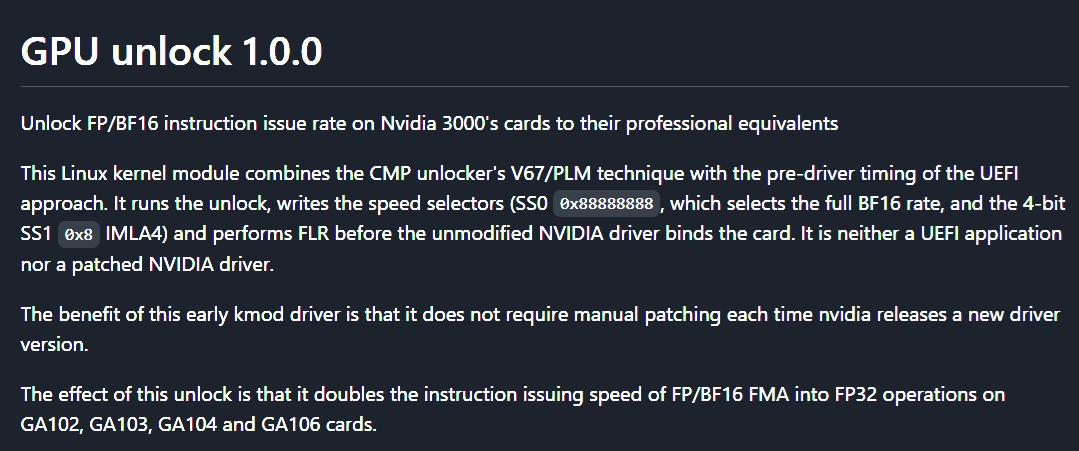
The limit being removed is small and specific. On consumer Ampere chips, the rate at which FP16 and BF16 fused multiply-add instructions can be issued into FP32 accumulation is held below what the same silicon does in a professional card. GPU Unlock targets that issue rate, not the clock or the memory.
Its approach borrows from the CMP mining-card scene. The module runs from the initramfs, after the PCI bus is enumerated but before the NVIDIA driver binds the card, and combines the CMP unlocker’s V67/PLM technique with the early-timing approach previously done from UEFI. It writes the speed selectors — SS0 0x88888888, which selects the full BF16 rate, and the 4-bit SS1 0x8 IMLA4 — performs a function-level reset of the card, and then lets the unmodified driver initialise it normally.
That design has two practical consequences. Because it is neither a firmware flash nor a patched driver, a driver update does not undo it and there is no re-patching ritual every release. And because it runs at boot, it is opt-in through the kernel command line: gpu_unlock.targets=all for every unbound GA102/GA103/GA104/GA106 card, or a comma-separated list of PCI addresses. Remove that argument and the unlock stops.
What It Buys in an LLM
The numbers come from user compatibility reports rather than a controlled study, and the project says so. The cleanest case is an RTX 3090 Ti at a 450 W power limit, running a dense 8192³ GEMM with FP32 accumulation as the median of five samples: BF16 rises from 87.50 to 157.41 TFLOPS, FP16 from 87.46 to 118.39, and TF32 from 42.58 to 82.61. An RTX 3080 10 GB in the same benchmark family moves from roughly 65 to 110–113 TFLOPS at its stock 320 W.
For language models the effect lands almost entirely on prefill. Matrix-heavy work speeds up — the reports put LLM prefill at 14–36% faster, with gains also reported for diffusion and FlashAttention — while decode, which is bound by memory bandwidth rather than instruction issue, stays about where it was. INT8 work is also unchanged. Where reports compared outputs, they found them bit-identical before and after.
Coverage is uneven, and the table is worth reading before buying anything. RTX 3090 Ti, 3090, 3080 10 GB, 3070 and 3060 12 GB are all reported as unlocked, with BF16 GEMM gains from about +25% (a card capped at 225 W) to +81%. The RTX 3080 Ti 20 GB OEM part is the notable miss: the unlock completes but BF16 stays at half rate. GA103 has no reports yet. The project notes that gains are each report’s own benchmark, so they are not directly comparable.
A Caution Before You Try It
This is an unsupported configuration, and it can compromise system stability. It removes a limit NVIDIA set in factory firmware, on hardware still under whatever warranty remains, using a module that runs before the graphics driver does. The project documents several behaviours worth understanding before you add it to a boot entry.
The module resets the card as part of the unlock, so the display output goes blank from that reset until nvidia-drm takes over; if the card is your only display adapter, expect to lose the screen briefly on every boot. Suspend to RAM powers the cards off and wipes the speed selectors, so the module re-runs the unlock on resume, adding about a second — but hibernation is not covered at all. If a card’s firmware does not stop during the unlock, the README says the module logs it and holds the DMA buffers that firmware may still touch until the next power off, and that you should power off rather than retry. A card that another driver has already initialised is refused rather than forced.
The thermal story is the one users notice. Doubling issue rate is not free: one RTX 3080 report in the project’s issue tracker shows the card drawing 380 W on a cold boot after unlocking, against 300 W before, and 350 W after a warm reboot. Higher sustained draw means more heat and more fan noise, and a card whose cooling or power delivery was already marginal has less headroom than it did in a gaming workload.
The project itself is candid about the limits of its own data: results are user-reported, the module accepts every GeForce ID in its device list regardless of whether anyone has confirmed it, and compatibility is not guaranteed. It ships GPL-2.0 for the module and packaging, while the firmware payload it generates derives from the pinned CMP reference and remains under NVIDIA’s terms. Windows is not supported — this is Linux only.
Prices Are Already Moving
The second-order effect showed up within days. Wccftech reports the RTX 3090 24 GB selling for around $1,000 before the tool circulated and above $2,000 after, with the 3090 Ti approaching $3,000 and 3080 10–12 GB cards reaching $900–$1,100 on eBay. Whether that holds depends on how many of these cards still work, but the direction is consistent with what happened to used 3090 prices every previous time local inference got cheaper.
What This Means
The interesting claim here is not that old GPUs got faster. It is that the gap between a consumer card and a professional one was, in this one respect, a fuse rather than a manufacturing difference — and that a mining-era firmware trick, a boot-time kernel module and a community issue tracker were enough to blow it. NVIDIA segmented its stack on issue rate for years; a 7,200-star GitHub repository has now made that segmentation a boot flag.
For anyone running models locally, the practical reading is narrow. If you already own an RTX 3090 or 3080 and your workload is prefill-heavy — long prompts, retrieval, batch work — the reported 14–36% is real and costs nothing but a reboot. If your workload is token-by-token generation, or your card is already at its thermal limit, there is much less to gain and more to lose. And if you are buying, the arbitrage that made these cards cheap has visibly closed.
This post was drafted with AI assistance and reviewed by RITS staff.
Sources
- Zagitta — GPU Unlock (GitHub, v1.0.0)
- Wccftech — NVIDIA GeForce RTX 30 GPUs Get Up To 2X Faster AI Compute Performance With New GPU Unlock Mod (October 24, 2026)
- Wccftech — NVIDIA RTX 30 & RTX 40 GPUs Get Impressively Fast In AI LLMs As Compute Doubles With New Unlock Tool But Prices Surge Too (October 24, 2026)
- GPU Unlock issue #1 — RTX 3090 Ti GEMM benchmarks


 沪公网安备31011502017015号