IntermediateAI
OpenAI’s GPT-6.1 Terra Halves Prices and Triples Task Speed
- OpenAI
- agentic ai
- benchmark
- computer use
- gpt-6.1
OpenAI released GPT-6.1 Terra on October 26, 2026, at $1 per million input tokens and $5 per million output tokens — half the standard API price of both GPT-5.6 Terra and GPT-6.1 Sol, the more capable model one rung above it. OpenAI pitches Terra as the tier for high-volume computer work: reading incoming invoices into accounting software, turning technical drawings into 3D models, reviewing a film shot by shot. The price cut is not the interesting part on its own. What is interesting is where the cut lands on the cost-intelligence curve, and how much of Terra’s advantage comes from a setting the buyer chooses rather than from the weights.

The Rung Terra Skipped
Terra’s previous release was GPT-5.6 in July 2026, when OpenAI shipped the Sol, Terra and Luna family together. In September the company moved Sol and Luna to the GPT-6 generation and left Terra where it was. This week’s release takes Terra from 5.6 straight to 6.1, skipping GPT-6 entirely. OpenAI’s ladder now reads Luna, Terra, Sol and Astra from cheapest to most capable, and Terra is the second rung — the model a company reaches for when the task is repetitive, the volume is high, and a wrong answer has to be cheap to catch.
It is rolling out to Plus, Pro, Enterprise and Edu accounts in ChatGPT Work and Codex, and is available to developers as gpt-6.1-terra. What ships is a reasoning model with selectable effort, text and image input, text output, and a 1M-token context window. Artificial Analysis measured 91 output tokens per second at its default configuration, which it describes as faster than the median of the models it tracks, and rates the model as somewhat verbose: it produced 130 million output tokens across the Intelligence Index suite, against a median of 81 million. OpenAI’s own speed claim is about task completion rather than tokens — it says Terra finishes tasks more than three times faster than GPT-6 Astra and GPT-6.1 Sol.
Price, and What It Buys
| Per million tokens | GPT-5.6 Terra | GPT-6.1 Terra |
|---|---|---|
| Input | $2.00 | $1.00 |
| Cached input | $0.20 | $0.05 |
| Output | $12.00 | $5.00 |
Figures for GPT-5.6 Terra are Artificial Analysis’s list prices; GPT-6.1 Terra’s are from OpenAI, which also puts cache writes at $1.25 per million tokens, half the previous rate.
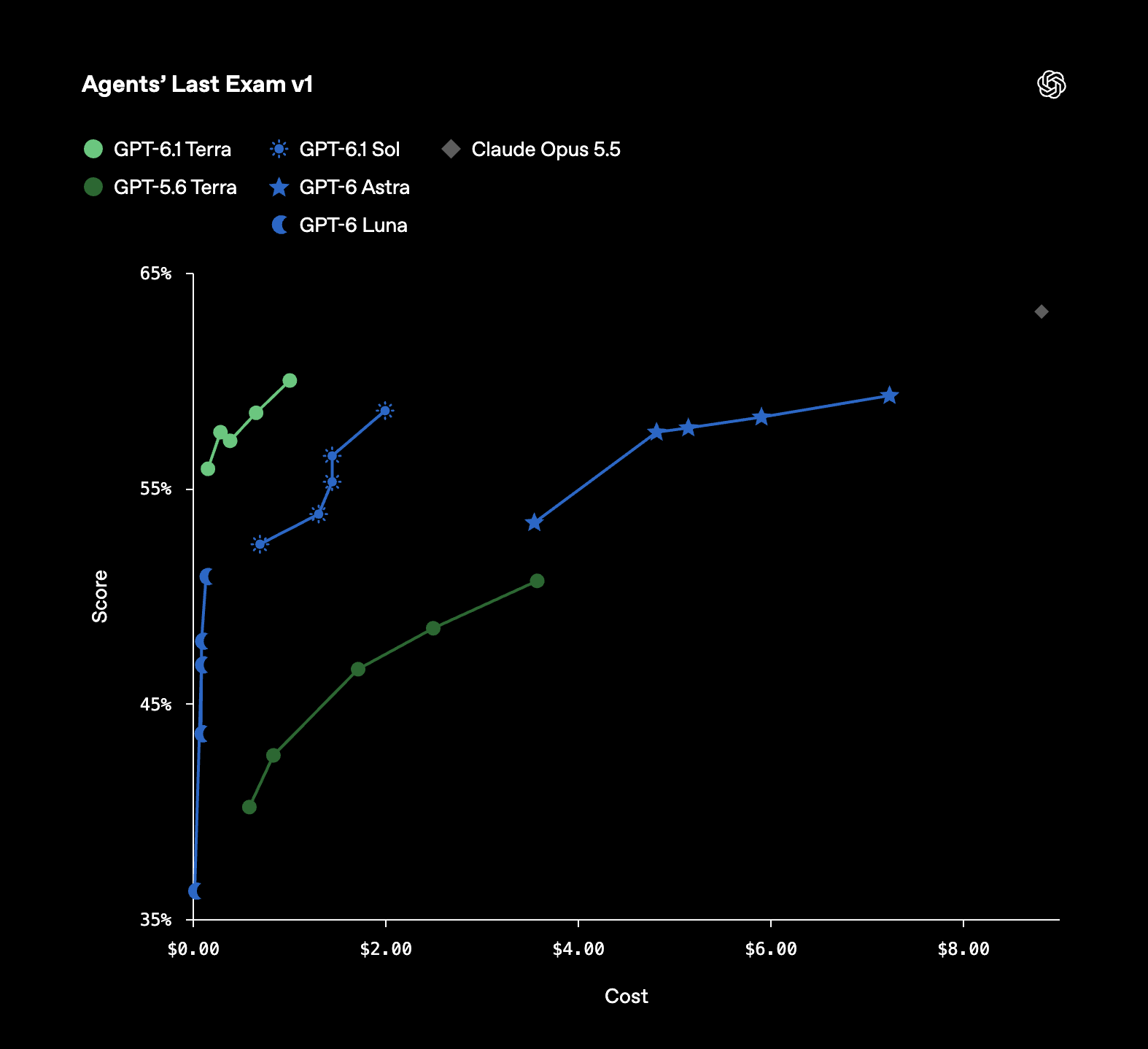
OpenAI’s benchmark claims are large and mostly about agents doing work on a screen. On Agents’ Last Exam, the company says GPT-6.1 Terra at medium effort scores 15 percentage points above GPT-5.6 Terra at roughly a third of the cost, and performs on par with GPT-6 Astra at a tenth of Astra’s price per token. On Terminal-Bench 4.0, which tests command-line problem solving, it reports 50.3% at maximum effort against 21.5% for GPT-5.6 Terra. On Terminal-Bench-Science 0.1 it says Terra beats GPT-6.1 Sol at lower cost and comes within five points of Claude Opus 5.5 at under a fifth of the estimated cost. At max effort against Opus 5.5, OpenAI claims roughly 9x lower cost per task, on the strength of more than three times the token efficiency at a quarter of the price per token.
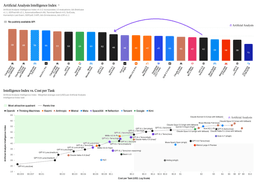
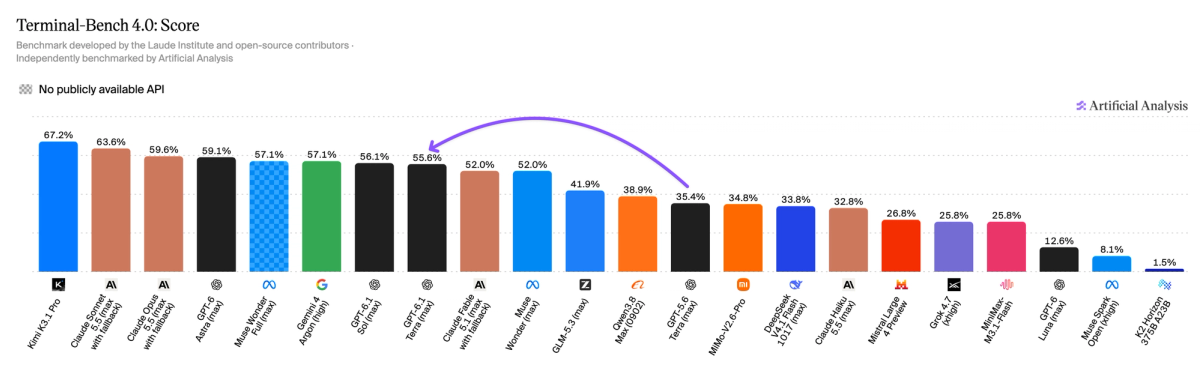
Artificial Analysis, which runs its own harness rather than quoting vendor results, reaches a similar conclusion with smaller numbers. It places GPT-6.1 Terra at 48 on its Intelligence Index v4.3.2 — 25th of 221 models — four points below GPT-6.1 Sol and ten above GPT-6 Luna, at $0.40 per benchmark task against $1.40 for GPT-5.6 Terra. On the firm’s new Coding Agent Index v2.0 the model scores 48, six points under Sol’s 54 and seventeen over Luna’s 31. Its measured Terminal-Bench 4.0 gain over GPT-5.6 Terra is about 20 points rather than the 28.8 implied by OpenAI’s two published figures, which is what one expects when two parties run the same benchmark under different conditions.
The Effort Dial Is Part of the Product
The most useful finding in the independent evaluation is not a score. It is that Terra is not one model on the cost-efficiency frontier but several, and only some of them sit on it. Artificial Analysis reports that the low and medium reasoning settings are Pareto-optimal for intelligence against cost, with gains over GPT-5.6 Terra of 7 to 13 points at those settings, while the higher settings fall behind the frontier; in the Coding Agent Index the same pattern holds for the xhigh and low settings. OpenAI’s own headline numbers lean on exactly that structure — the 15-point Agents’ Last Exam gain is quoted at medium effort, the 9x cost advantage at maximum.
That matters for anyone comparing models from a spec sheet. A single “GPT-6.1 Terra” score is really a choice about how much compute to spend per answer, and the cheapest defensible setting is often two rungs below the maximum. It also shows up in the API surface. A developer note in OpenAI’s announcement thread points out that the model accepts reasoning.effort: "none", which then allows temperature and top_p — parameters that were blocked on GPT-6.1 Sol. For workloads that need deterministic sampling rather than reasoning, that is a more consequential detail than the index score.
Hallucination and the Safety Rating
The factuality numbers are the strongest part of the release. On Artificial Analysis’s AA-Omniscience benchmark, GPT-6.1 Terra guesses 38% of the time when it does not know an answer, against 88% for GPT-5.6 Terra — a 50-point drop in the hallucination rate — and it does so while gaining two points of accuracy, meaning it is both abstaining more and answering more questions correctly. OpenAI reports the same direction on its internal benchmark of error-inducing prompts: a fall from 53.6% to 16.7% at low effort, and to 4.3% at maximum effort, close to GPT-6 Astra and GPT-6.1 Sol. A model that says less when it is unsure is cheaper to run in a pipeline, but it also changes what an agent does at the moment it gets stuck, and that is worth testing rather than assuming.
The safety line in the announcement deserves more attention than it usually gets. OpenAI states that “GPT-6.1 Terra meets the Critical threshold in cybersecurity under our Preparedness Framework, and maintains the protections developed for GPT-6 Astra.” Critical is the highest tier in that framework, and the system card published the same day carries the evaluations behind it, including ExploitBench and Sandbox Bench. OpenAI also says the model is more likely than GPT-5.6 Terra to stay within scope, to disclose limitations and blockers, and to resist prompt injection — claims that live in the system card rather than the blog post.
What This Means
For teams automating clerical and screen-bound work, this is the release that resets the default. Reading invoices, filling forms, turning a drawing into a model: tasks that were uneconomic at $12 per million output tokens become viable at $5, and the $0.05 cached-input price makes repeated context nearly free. The gap between Terra and Sol also narrows to four index points, which means most production traffic should now be routed to the cheaper model with a fallback, not to the flagship.
Two cautions. First, most of the headline gains are vendor-measured, on benchmarks OpenAI chose, at effort settings OpenAI chose; the independent index agrees on direction but not on magnitude. Second, a Critical cybersecurity rating on a model sold at a fifth of last year’s mid-tier price is a deployment question, not a footnote — the useful reading is the system card’s ExploitBench and Sandbox Bench sections, not the announcement. The competitive pressure is real, though: a mid-tier model that matches the previous flagship on agentic work at a tenth of the token price compresses the whole market toward Terra’s rung.
This post was drafted with AI assistance and reviewed by RITS staff.
Sources
- OpenAI — Introducing GPT-6.1 Terra (October 26, 2026)
- OpenAI Deployment Safety Hub — Addendum to GPT-6 Astra System Card: GPT-6.1 Terra
- Artificial Analysis — GPT-6.1 Terra pushes the cost efficiency frontier (October 26, 2026)
- Artificial Analysis — GPT-6.1 Terra model page
- OpenAI API documentation — GPT-6.1 Terra model page
- OpenAI Developer Community — GPT-6.1 Terra announcement thread
- 9to5Mac — OpenAI upgrades ChatGPT and Codex with new GPT-6.1 Terra model



 沪公网安备31011502017015号