Apple Open-Sources Its Foundation Models Framework, Adds Claude and Gemini


At WWDC 2026 on June 9, Apple announced it will open-source its Foundation Models framework — the on-device AI layer that powers Apple Intelligence — later this summer. Alongside the open-source pledge, Apple opened the framework to third-party models like Claude and Gemini, added image input, and made its newest cloud models free to small developers on Private Cloud Compute. It is the company’s most significant move yet toward turning Apple Intelligence into an open developer platform rather than a closed feature set.
Intermediate

What Apple Announced
The headline for developers is that the Foundation Models framework — the native Swift API Apple shipped in 2025 for tapping its on-device models — will go open source later this summer. Apple is also open-sourcing two companion implementations, CoreAILanguageModel and MLXLanguageModel, which let developers run a wide range of local models on the Apple Neural Engine and Mac GPU.
Just as important is what the framework now connects to. A new LanguageModel protocol lets nearly any model — Apple’s own, or a remote provider — back a LanguageModelSession behind a single Swift API. Anthropic and Google are both shipping Swift packages so developers can call Claude and Gemini through the same interface they already use for on-device inference. A new Dynamic Profiles system lets an app swap models, tools, and instructions mid-session, which Apple is positioning as the foundation for multi-agent workflows.
The framework also gains image input, so models can reason over pictures alongside text, with direct access to the Vision framework’s on-device OCR and barcode readers.
The Models Behind It
Powering all of this is Apple’s third generation of foundation models (AFM 3), a five-model lineup spanning on-device and cloud. The most interesting is the on-device AFM 3 Core Advanced: a 20-billion-parameter sparse model that activates only 1–4 billion parameters per prompt using a technique Apple calls Instruction-Following Pruning. According to Apple’s research, the roughly 3B-activated configuration outperformed a 3B dense baseline by 5–8 absolute points on math and coding while matching a 9B dense model — a strong efficiency win for hardware-constrained devices.

Apple’s own human-preference evaluations show clear generational gains over its 2025 models — for example, the Core Advanced text model was preferred 44.7% of the time versus 17.6% for the prior generation. The caveat worth flagging: Apple published no third-party benchmarks such as MMLU, SWE-bench, or GPQA, so these numbers compare Apple to Apple, not to frontier models from OpenAI, Anthropic, or Google.
Free Cloud Access for Small Developers
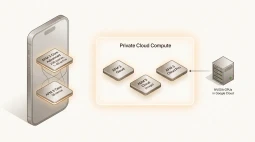
To lower the barrier to building AI features, Apple is giving developers in the App Store Small Business Program — those with fewer than two million total first-time downloads — free access to its next-generation cloud models running on Private Cloud Compute, with no per-token API cost. Apple is pairing this with new developer tooling: an fm CLI and Python SDK for AI-powered scripts, and an Evaluations framework for verifying that AI features behave correctly across changing conditions.
What This Means
Apple has historically kept its AI stack tightly closed, so open-sourcing the framework and embracing rival models is a notable shift. For developers, it means one Swift API can route between a private on-device model, Apple’s free cloud tier, or a frontier model like Claude — chosen per request based on cost, latency, and privacy. For the broader ecosystem, it nudges Apple Intelligence toward being a neutral orchestration layer rather than a walled garden. The open questions remain Apple’s silence on independent benchmarks and the geographic limits on Apple Intelligence — it is unavailable in mainland China pending approval, and Siri’s AI features are restricted in the EU at launch.
Related Coverage
- Apple’s Simple Self-Distillation Boosts Code Generation by 30% — earlier Apple research on improving on-device code generation
- TinyGPU Brings NVIDIA and AMD eGPUs to Apple Silicon Macs — opening up the Apple Silicon hardware stack
This post was drafted with AI assistance and reviewed by RITS staff.


 沪公网安备31011502017015号